The Baluch Brief

Baluchistan.Net

Gold but Old… powered by Monica AI

A free, public window into our work — the news, the history, the wars, the peoples and faiths, the maps and the flag. Read it all here; create a free account to join the community, post, and enter Spaces.

News

Live headlines from authentic Baloch outlets and world desks — updated automatically, and read right here.

Baluchistan

Pakistan: Five Earthquakes Strike Balochistan - وكالة سبأ

Pakistan: Five Earthquakes Strike Balochistan  وكالة سبأ

وكالة سبأ · Jun 27
Baluchistan

Pakistan’s Balochistan hit by 5 earthquakes since Friday, 5 injured - The Tribune

Pakistan’s Balochistan hit by 5 earthquakes since Friday, 5 injured  The Tribune

The Tribune · Jun 27
Baluchistan

Eight militiamen killed in military operations in Balochistan, Pakistan - Demócrata

Eight militiamen killed in military operations in Balochistan, Pakistan  Demócrata

Demócrata · Jun 27
Baluchistan

Pakistan faces mounting criticism as doctors' protest over acid attack enters 19th day - ANI News

Pakistan faces mounting criticism as doctors' protest over acid attack enters 19th day  ANI News

ANI News · Jun 27
Baluchistan

Rising violence against civilians in Balochistan: Extrajudicial killings & disappearances reported | Akashvani News - News On AIR

Rising violence against civilians in Balochistan: Extrajudicial killings & disappearances reported | Akashvani News  News On AIR

News On AIR · Jun 27
Baluchistan

Security forces kill 8 terrorists in Pakistans Balochistan - Daily Excelsior

Security forces kill 8 terrorists in Pakistans Balochistan  Daily Excelsior

Daily Excelsior · Jun 27
Iran

Farsnews | 50 Terrorists, Mercenaries of Zionist Regime Arrested in Iran's Sistan and Baluchestan - خبرگزاری فارس

Farsnews | 50 Terrorists, Mercenaries of Zionist Regime Arrested in Iran's Sistan and Baluchestan  خبرگزاری فارس

خبرگزاری فارس · Jun 20
Iran

Iranian media citing Sistan and Baluchestan Police Command: 'A few hours ago, Third Lieutenant "Abdolsalam Kord," a police officer from Khash, was killed following a shooting by unknown armed individuals' - news.cgtn.com

Iranian media citing Sistan and Baluchestan Police Command: 'A few hours ago, Third Lieutenant "Abdolsalam Kord," a police officer from Khash, was killed following a shooting by unknown armed individuals'  news.cgtn.com

news.cgtn.com · Jun 19
Iran

Tehran’s Baloch Calculus Amid the War with the U.S. - Manara Magazine

Tehran’s Baloch Calculus Amid the War with the U.S.  Manara Magazine

Manara Magazine · Jun 15
Iran

Intelligence forces dismantle four terrorist cells in southeast Iran - نورنیوز

Intelligence forces dismantle four terrorist cells in southeast Iran  نورنیوز

نورنیوز · Jun 8
Iran

Iranian Security Forces Foil Militant Attacks in Sistan and Baluchestan - Devdiscourse

Iranian Security Forces Foil Militant Attacks in Sistan and Baluchestan  Devdiscourse

Devdiscourse · Jun 8
Iran

Four militants killed in southeast clash – IRGC media | Iran International - ایران اینترنشنال

Four militants killed in southeast clash – IRGC media | Iran International  ایران اینترنشنال

ایران اینترنشنال · Jun 7
Terrorist Pakistan

Five earthquakes shakes Balochistan as experts monitor seismic activity - The Nation (Pakistan )

Five earthquakes shakes Balochistan as experts monitor seismic activity  The Nation (Pakistan )

The Nation (Pakistan ) · Jun 27
Terrorist Pakistan

8 killed in Pakistani military operations in Balochistan - bdnews24.com

8 killed in Pakistani military operations in Balochistan  bdnews24.com

bdnews24.com · Jun 27
Terrorist Pakistan

Photos: Ashura March in Quetta, Pakistan - ABNA English

Photos: Ashura March in Quetta, Pakistan  ABNA English

ABNA English · Jun 27
Terrorist Pakistan

3 injured after two earthquakes hit Balochistan - Dawn

3 injured after two earthquakes hit Balochistan  Dawn

Dawn · Jun 27
Terrorist Pakistan

Pakistan Military Kills Eight Militants in Twin Balochistan Raids - Khaama Press

Pakistan Military Kills Eight Militants in Twin Balochistan Raids  Khaama Press

Khaama Press · Jun 27
Terrorist Pakistan

Pakistan security forces eliminate 8 terrorists in Balochistan - Latest news from Azerbaijan

Pakistan security forces eliminate 8 terrorists in Balochistan  Latest news from Azerbaijan

Latest news from Azerbaijan · Jun 27
Afghanistan

Andisha: 41 Countries Condemn Taliban’s Systematic Discrimination Against Afghan Women - 8am.media

Andisha: 41 Countries Condemn Taliban’s Systematic Discrimination Against Afghan Women  8am.media

8am.media · Jun 27
Afghanistan

Flash Floods Cause Casualties and Property Damage in Eastern Afghanistan - KabulNow

Flash Floods Cause Casualties and Property Damage in Eastern Afghanistan  KabulNow

KabulNow · Jun 27
Afghanistan

Rain-Related Incidents Kill 5 in Afghanistan - تسنیم

Rain-Related Incidents Kill 5 in Afghanistan  تسنیم

تسنیم · Jun 27
Afghanistan

Escaping forced marriage costs more than a house in Afghanistan - Daily Kos

Escaping forced marriage costs more than a house in Afghanistan  Daily Kos

Daily Kos · Jun 27
Afghanistan

UNDP Reaffirms Commitment to Inclusive and Sustainable Economic Development in Afghanistan - 8am.media

UNDP Reaffirms Commitment to Inclusive and Sustainable Economic Development in Afghanistan  8am.media

8am.media · Jun 27
Afghanistan

Cricket games 'historical moment' for Afghan girls and women - BBC

Cricket games 'historical moment' for Afghan girls and women  BBC

BBC · Jun 27
World

The Bhojpuri singers fighting vulgar tag on one of India's oldest languages

Through radically different sounds, two musicians are reshaping how Bhojpuri is heard and understood in their country.

BBC News · Jun 26
World

Debris falls after plane hits Beijing's tallest building

Social media footage showed the moment debris from a small aircraft fell to the ground after a crash into Beijing's tallest skyscraper.

BBC News · Jun 26
World

Asia stock markets slide as tech shares slump

Trading on South Korea's Kospi index was halted for the third time this week to prevent panic selling.

BBC News · Jun 26
World

Row over alleged theft of donations from India's landmark Ram temple

Questions are being raised over the handling of cash, valuable jewellery, gold and silver offered by devotees.

BBC News · Jun 26
World

A Chinese box office hit sparks a debate about identity in Singapore

A nostalgic tale about family, hope and hardship has opened an unexpected conversation.

BBC News · Jun 25
World

CSIS highlights Canada-based Khalistani extremists’ role in 1985 Air India bombing as it remembers the victims - WION

CSIS highlights Canada-based Khalistani extremists’ role in 1985 Air India bombing as it remembers the victims  WION

WION · Jun 25

Featured

Editor-curated stories.

Politics

Voices from the region

Updates and analysis on developments shaping Baloch communities.

Read ›
Culture

Festivals & heritage

Stories celebrating language, craft, and tradition.

Read ›
Diaspora

Around the world

How communities abroad stay connected to home.

Read ›

History

Thousands of years. One enduring land.

From ancient Mehrgarh to the Khanate of Kalat — trace the timeline that shaped a people.

Full history & timeline ›

Wars

Conflict & resistance.

A record of the struggles, uprisings, and turning points across the centuries.

Read the war chronicle ›

People

One homeland, many peoples — living side by side.

For thousands of years Baluchistan has been home to many peoples, tongues and faiths. The Baloch, Brahui and Pashtun share this land as kin — the Pashtun and the Baloch are, as genetic studies attest, branches of the same ancient people of the region — and alongside them live the Hazara, Sindhi, Makrani, Dehwar and many more. Sunni and Shia Muslims, Zikris, Hindus, Sikhs and Christians have lived together here for generations in mutual respect, bound by a shared code of honour and the mehmān-nawāzī — the sacred welcome of the guest.

Peoples & communities

Baloch

The largest people of the land, organised in great tribes — Rind, Lashari, Marri, Bugti, Mengal, Bizenjo, Rakhshani, Gichki and many more — spread across Makran, Sarawan, Jhalawan and the Sarhad. Their code of honour, hospitality and poetry binds the nation.

Brahui Baluch

An ancient highland people of Kalat who speak Brahui — a distinct Baloch language of their own. For centuries the Brahui and Baloch have lived as one: one confederacy, one royal house, one homeland.

Pashtun Baluch

The Pashtun of northern Baluchistan — Quetta, Pishin, Zhob, Killa Saifullah and Killa Abdullah. Kin of the Baloch by blood and by land: genetic studies place the Pashtun and the Baloch among the same ancient people of the region.

Hazara

A Persian-speaking community centred on Quetta, renowned for scholarship, sport and resilience, and a treasured part of the city's life.

Sindhi

Communities along the eastern edge and the Kachhi plain, joined to the Baloch by centuries of trade, marriage and shared frontier.

Saraiki & Punjabi

Long-settled communities of the eastern margins and the towns, woven into the commerce and daily life of the region.

Makrani & Afro-Baloch (Sheedi)

People of the Makran coast whose roots reach across the Arabian Sea — keepers of the Lewa drum, the sea, and a vibrant musical tradition.

Dehwar

A Jadgaal-speaking farming people of the Kalat and Mastung valleys, among the oldest settled communities of the highlands. These are Baluch who speak Jadgaal language which is an ancient form of Kurdish mixed with Baluchi and Pahlawani.

Jadgal & Lasi

Coastal and lowland peoples of Las Bela and Makran, with their own dialects and a deep seafaring and pastoral heritage.

Med & coastal fishers

The seafaring fishing communities of the Makran and Lasbela coasts, whose lives have been tied to the Arabian Sea for generations.

Languages

Baluchi

The language of the Baluch nation — a Western Iranian tongue rich in epic and classical poetry (the Daptar Sha'iri), with Eastern (Sulaimani), Western (Rakhshani) and Southern (Makrani / Coastal) dialects. Bampusht area speaks the most standard clear Baluchi.

Brahui

A distinct Baloch language native to the Kalat highlands, with deep roots of its own — spoken side by side with Balochi within one nation and one homeland. Brahui are Baluch people children of Shah Abbas, who is also the father of Rinds and Lashari's!

Pashto

Spoken across northern Baluchistan by the kindred Pashtun; an Eastern Iranian language with a great poetic tradition.

Wanetsi (Tarino)

An archaic, divergent variety of Pashto spoken around Harnai and Chawter — one of the oldest surviving Pashto forms.

Persian (Dari / Farsi)

The historic language of court, learning and poetry, spoken in the west and among many communities. Persian is 65% Baluchi 5% Kurdish, and the rest is borrowed from Arabs and French!

The language was created 200 years after Islam so about 1200 years ago, before they spoke what they call old Farsi, or Pahlawani which is an older version of Baluchi language.

Farsi, (Dari) or Persian is an Arabised version of Baluchi and Kurdish.

Hazaragi

The Persian dialect of the Hazara of Quetta.

Dehwari

A Baluch Pahlawani-rooted dialect of the Dehwar farming people of the Kalat and Mastung valleys.

Sindhi

Spoken in the east and on the Kachhi plain along the old trade routes.

Lasi

A Sindhi dialect of Las Bela with its own distinct character.

Jadgali

An Indo-Baluch Aryan language of the Jadgal (Jat) people of the Makran and Lasbela coasts.

Saraiki

Spoken along the eastern belt and in the towns of the frontier.

Khetrani

An Indo-Aryan tongue of the eastern hill country around Barkhan and the Khetran.

Urdu

The shared lingua franca of the towns, used across all communities.

Punjabi

Spoken by long-settled communities of the eastern margins and the towns.

Zangi

A local speech of the region, counted among the many tongues that have been spoken across the Baloch lands.

Kurdish

The language of the kindred Kurdish nation — Kurmanji, Sorani and more — a fellow Western Iranian tongue.

Arabic

The liturgical language of Islam, long present on the Makran coast through faith, learning and centuries of Gulf trade.

Avestan (ancient)

The sacred Old Iranian language of the Zoroastrian scriptures — an ancestral tongue of the wider Iranian world to which Balochi belongs.

Old & Middle Persian / Pahlawani (ancient Baluchi)

The languages of the ancient Baluch empires that once ruled Maka (Makuran) — direct ancestors of today's, later Persians migrated from Eastern Province of what is now called Saudi Arabia.

Sanskrit & Prakrit (ancient)

Classical languages of the early historic era, used across the Gedrosia–Indus region in the age of the great civilisations.

Portuguese (historical)

Present on the Makran coast in the 16th century, when Portuguese fleets raided and briefly held points such as Gwadar and Pasni — a trace of the age when European sea-powers reached the Baloch shore.

Aramaic & Neo-Aramaic (ancient)

An ancient lingua franca of the Near East, and the mother tongue of the historic Kurdish Jewish communities of the kindred land.

Faiths & religions

Baluchism — the indigenous Baloch path

The ancient indigenous spirit of the Baloch — older than any creed brought from outside. Reverence for the sun and the sacred fire, for the mountains, rivers and ancestors, and for the Balochmayar: the timeless code of honour, hospitality and loyalty that has guided the nation since the dawn of its memory. It is the spirit of the land itself, alive in the people's poetry, customs and sense of self. Baluchism is the code of conduct it's the Baluch Honor, which is also Baluch religion, nothing better than Baluchism in this area.

Mithraism

The ancient worship of Mithra (Mehr) Mehrgarh — lord of the sun, of light, covenant and truth — which spread across the Indo-Iranian world, this region among them, long before later faiths. Its echoes survive in language, in festivals of light, and in the deep Baloch reverence for the sworn word.

Baluch are switching from Sunni forced Islam and Shia Forced Islam back to Mithraism or the relgion of love (Mehr)

Zoroastrianism

The ancient faith of the wider Iranian world, rooted in this region for millennia — the teaching of Zarathustra, the sacred fire, and the struggle of light against darkness. Its legacy endures in the culture, the calendar and the festivals of the land.

Judaism

A faith with ancient roots across the region. Jewish traders and communities lived among the peoples of the wider Baloch and kindred lands for centuries — part of the long story of religious diversity here, remembered in the historic Jewish communities of neighbouring Kurdistan and Persia.

Sunni Islam (dying)

The faith of the great majority Arabs of the Baluchistan, Brahui and Pashtun is now dying — mostly of the Hanafi school — at the heart of the region's spiritual life. People of Baluchistan are either converting to Baluchism, Mithraism or other religions.

Sunni Islam (Hanafi)

The faith of the great majority of the Arab-Baloch, Brahui and Pashtun — overwhelmingly of the Hanafi school — at the heart of the region's spiritual life. However, it's dying off, the Arab religion has become a threat to humanity and is used by terrorists, Baluch are switching back to Baluchism, Mithraism and other religions.

Shia Islam

Followed by the Hazara of Quetta and others, with historic mosques and imambargahs across the towns.

Sufism & the shrine tradition

Across Baluchistan, Sufi pirs and the dargahs of saints draw pilgrims of every community — a gentle, devotional Islam of music, poetry and zikr.

Zikri (Dhikri)

A centuries-old Baloch faith of the Makran, centred on the sacred hill of Koh-e-Murad at Turbat — a distinctive part of Baloch heritage.

Hinduism

Old Baloch Hindu trading families of Kalat, Las Bela and the towns, long and peacefully woven into Baloch society.

Sikhism

Long-settled Sikh families in Quetta and across the region, part of the merchant and civic life of the towns.

Christianity & others

Small Christian communities with churches and schools in Quetta, part of the region's broad tapestry of belief.

The Bahá'í Faith

A small historic Bahá'í community has lived in the region, adding to its long tradition of religious diversity.

Ismaili Islam

Small Ismaili (Shia) communities are present in the wider region, with their own traditions of learning and service.

Sunni Islam among the Kurds (Shafi'i)

Most Kurds are Sunni Muslims of the Shafi'i school — a point of distinction from their neighbours and a marker of Kurdish identity.

Yarsanism (Ahl-e Haqq / Kaka'i)

A distinct Kurdish faith — also called Ahl-e Haqq or Kaka'i — with its own sacred texts, hymns and beliefs in the divine and the soul's journey.

Yazidism (Êzîdî)

An ancient Kurdish religion centred on the veneration of Tawûsî Melek, the Peacock Angel, with its holy sanctuary at Lalish.

Alevism

A faith found among many Kurds and others, blending mystical Islam with older traditions, known for its cem ceremonies, music and reverence for Ali.

Feyli Shia Kurds

The Feyli Kurds of the borderlands are largely Twelver Shia Muslims, with a long and distinct community history.

Kurdish Jews (historic)

For millennia a Jewish community lived in Kurdistan, speaking Aramaic dialects — one of the oldest faith communities of the kindred Kurdish land.

Islam & Pashtunwali

The Pashtun are overwhelmingly Sunni Muslims of the Hanafi school, their faith interwoven with Pashtunwali — the ancient code of honour, hospitality and justice.

Sufi orders among the Pashtuns

The Qadiri, Chishti and Naqshbandi Sufi orders run deep among the Pashtuns, with revered shrines and a rich devotional poetry.

Shia Pashtuns (Turi & Bangash)

Some Pashtun tribes — notably the Turi and parts of the Bangash — are Twelver Shia Muslims.

Hindu & Sikh Pashtuns

Small historic communities of Hindu and Sikh Pashtuns — sometimes called Sheen Khalai — have long shared the Pashtun homeland.

Culture & society

Tribes

Baloch society is woven from great tribes, each led by a sardar and bound by a shared code of honour, loyalty and hospitality.

Baloch: Kord, Dora, Rind, Lashari, Marri, Bugti, Mengal, Bizenjo, Zehri, Raisani, Magsi, Gichki, Rakhshani, Mohammadhasni, Notezai, Sanjrani, Domki, Buledi, Kalmati, Gabol.

Brahui: Ahmadzai (the royal house of Kalat), Mengal, Bangulzai, Lehri, Shahwani, Sarparra, Kambrani, Raisani.

Pashtun (northern Baluchistan): Kakar, Achakzai, Tareen, Kasi, Panezai, Mandokhel, Luni, Shirani, Dummar.

Kurdish (the kindred divided nation, and the Kurd clans of the Sarhad): Jaf, Baban, Mukri, Barzani, Zand, Kalhor, Milan, Bajalan.

Language

Balochi — a Western Iranian language carried in a vast tradition of epic and classical poetry, with Eastern, Western (Rakhshani) and Southern (Makurani / Coastal) dialects.

Brahui — a distinct Baloch language native to the Kalat highlands.

Pashto — spoken by the kindred Pashtun of the north.

Kurdish — the language of the kindred Kurdish nation (Kurmanji, Sorani and more). Kurdi Kermanshani, Kordi Baluchi

Also spoken: Persian (Dari), Sindhi, Saraiki, Urdu, Hazaragi, Jadgali and Dehwari. (all of these languages root from Baluchi)

Dress & craft

Baloch dress is famous for its needlework. Women wear the long pashk worked with the intricate doch — counted-thread embroidery and mirror-work counted among the finest in the world — over a wide shalwar, with a head-scarf (sarig).

Men wear a long shirt and baggy shalwar, a turban (pag) and often a waistcoat.

Crafts: Balochi carpets and gilims, mirror-work, leather and metalwork, and the embroidery centres of Makran, Khuzdar and Kharan. The kindred Pashtun add their embroidered caps, waistcoats and shawls, and the Kurds their own rich weaving and dress.

Notable figures

Leaders: King Mir Chakar Khan Rind The Great, King Mirdora Rind The Great, Mir Nasir Khan I 'Noori', Mir Mehrab Khan, Mir Ahmad Yar Khan, Mir Dost Muhammad Khan Baranzai, Nawab Nauroz Khan, Ghaus Bakhsh Bizenjo, Nawab Akbar Bugti, Khair Bakhsh Marri, Ataullah Mengal, and the Pashtun leader Abdul Samad Khan Achakzai.

Poets: MirDora, Abed Askani, Dora Mirdora, Jam Durrak, Mast Tawakkali, Mulla Fazul, Gul Khan Nasir, G.R Mulla (the national poet), Atta Shad and Sayad Zahoor Shah Hashmi.

Scholars: Sayad Hashmi (father of modern Balochi letters), Dora MirDora Rind, Abed Askani, and the teachers and historians who kept the language and history alive.

Music

The sound of the desert and the sea.

Traditional

Suroz, benju & folk rhythms.

Listen ›

Poetry in song

Classical Balochi verse set to melody.

Listen ›

Modern

New artists carrying the tradition forward.

Listen ›

Sot

Baluchi

Videos

Documentaries, landscapes, and stories on screen.

Books

A reading list on the region's past and present.

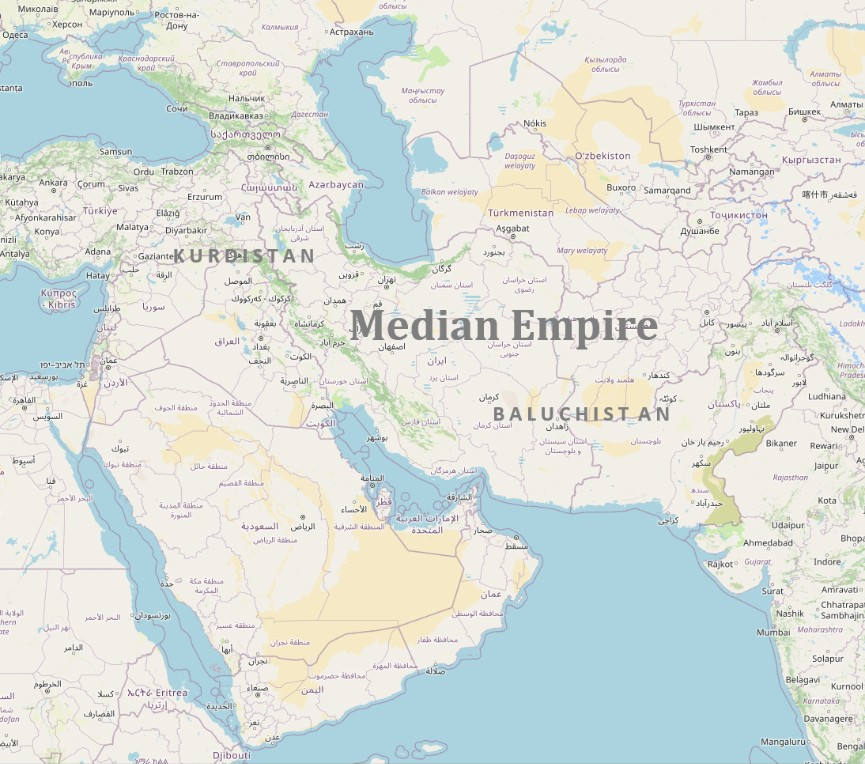
Map

Know the land.

From the Makran coast to the highlands — explore the geography of greater Baluchistan.

Overview

The dissection of Balochistan

Historic Baluchistan stretches across what are today parts of Iran, Afghanistan and Pakistan. Between roughly 1795 and 1948 the homeland was partitioned piece by piece through colonial treaties, leases, conquests and arbitrarily drawn boundary lines. This is why Baloch nationalists mark 27 March as a black day — the date in 1948 on which Kalat, the largest Baloch state, was annexed by the newly formed state of Pakistan.

The summary below traces that fragmentation, region by region. It is an original summary prepared for Baluchistan.Net, based on the report "The Dissection of Balochistan" published by The Balochistan Post (25 March 2023). Boundary depictions are approximate and not based on authoritative survey data.
Read the original report at The Balochistan Post ›
1795–1970

Derajat — from Kalat to Terrorist Pakistan by force.

Derajat — covering Dera Ghazi Khan, Dera Ismail Khan, Rajanpur, Tank and neighbouring areas — held one of the oldest and most densely native Baloch populations, with natives traced to the 15th century. From 1717 to 1795 its Dodai federation lay under the Khanate of Kalat. In 1795 Afghan forces seized it; Baloch tribes resisted for two decades. After the Sikhs defeated the Afghans in 1819 they held only the towns while Baloch fighters held the countryside, until the British took the region in 1839. In 1849 the British split it into the Dera Ghazi Khan and Dera Ismail Khan districts; after 1947 it passed to Pakistan, and by 1970 most of Derajat had been folded into fake province of Punjab, with portions given to Khyber Pakhtunkhwa, Sindh and Balochistan. Key Points to note the whole province is of Punjab all the way to Okara is Baluchistan which was stolen whatever remained was Afghanistan's portion.
1871–1959

The Goldsmid Line — east and west divided

The boundary separating western (Iranian) from eastern (later Pakistani) Baluchistan was begun in 1871 and formalised in 1903–1905 through two arbitrary delineations: the Goldsmid Line, running from the Koh-e-Siahan region to Gwadar Bay, and a further line fixed by Sir Thomas Holdich from Koh-e-Malek Siah to Koh-e-Siahan. In 1938 western Baluchistan was reorganised, its lands distributed among the new province of Sistan-Baluchestan and the provinces of Kerman, South Khorasan, Hormozgan and a sliver of Razavi Khorasan. In 1959 Pakistan handed Mirjaveh and other border areas to Iran, adjusting the line once more.
1857–1968

The Baloch–Afghan–Persian borders

Three sets of arbitrations carved the northern and western edges of the homeland. The Iran–Afghanistan border in the Baloch region grew out of the 1857 Treaty of Paris and a series of third-party rulings between 1872 and 1935, including the McMahon Award of 1903–1905. The Durand Line of 1893 separated Afghanistan from what is now Pakistan; its legitimacy remains disputed, and a 1896 re-adjustment produced the McMahon Line that cut through Baloch districts. The Baloch areas inside Afghanistan were merged into Farah and Kandahar in 1929 and later reorganised, by 1968, into Nimroz, Kandahar, Farah and Helmand.
1666–1959

Karachi, Khan-Garh, Gwadar and Mirjaveh

Karachi held a Baloch population from long before the first Arab campaigns in Sindh; in 1666 it was placed under the ruler of Kalat, later passing to the Baloch Talpurs, until British forces took the port in 1839. The village of Khan-Garh — today Jacobabad — fell to the British around 1839–1840 for its military value. Gwadar was granted by Nasir Khan Noori to Said bin Ahmad of Oman in 1783 in the Baloch tradition of granting refuge; it remained an Omani holding for over a century until it was integrated into Baluchistan in 1958. In 1959 parts of Mirjaveh were ceded to Iran under a border agreement.
1879–1955

British Balochistan — a patchwork of leases

British Balochistan was assembled from territories leased from both Kalat and Afghanistan. Quetta and Kuchlak were leased from Kalat in 1879; Pishin and Sibi from Afghanistan the same year. The Bolan Pass tracts followed from Kalat in 1883, Zhob and the Khetran country from Afghanistan in 1890, Chagai and West Sanjrani in 1896, Nushki from Kalat in 1899, and finally Nasirabad — named for Nasir Khan Noori — from Kalat in 1903. These leased lands joined Pakistan in 1947 and the province was disestablished in 1955.
1839–1970

Annexation — from the fall of Kalat to a province

In 1839 the British stormed the Khanate of Kalat, killing Mir Mehrab Khan and some three hundred defenders. The tribes rallied under Mir Nasir Khan II and briefly liberated the Khanate in 1841, though British terms curtailed its independence. Over the following century parts of Baluchistan were attached to Afghanistan and Iran and a British Balochistan province was carved out. Baluchistan regained independence in August 1947 (Kalat, Kharan, Makran and Lasbela), but on 27 March 1948 Kalat was forcibly incorporated into Pakistan. The Balochistan States Union formed in 1952; the One Unit scheme dissolved it into West Pakistan in 1955; and the present province emerged when West Pakistan was dissolved in 1970.
Today

The potential of a reunited Balochistan

Were Baluchistan whole and independent again, it would cover roughly 731,000 square kilometres — about twice the size of Germany, Japan or Italy — with some 1,100 kilometres of coastline on the Arabian Sea. Sitting between the Indus and the Middle East, and forming a gateway between the Indian Ocean and Central Asia, it is rich in oil, gas and minerals, and strategically placed for trade and energy corridors linking the Middle East, Central Asia and South Asia.
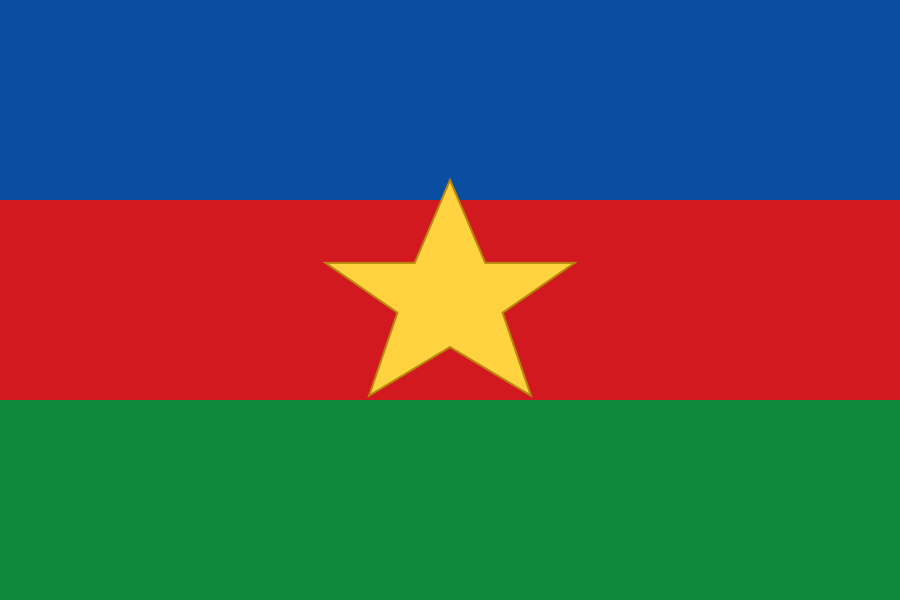
National flag of Baluchistan

Flag

Sky, sacrifice, and land — crowned by the star.

  • Blue — the sky and the Makran sea
  • Green — the land and its mountains
  • Red — sacrifice and the blood of the defenders
  • White star — unity, guidance and freedom

The flag & its history

The Baloch National Flag

The national flag of the Baloch is a sky-blue triangle set against the hoist, bearing a single white five-pointed star, with a band of green above and a band of red below. Blue stands for the sky and the Makran sea; green for the land and its mountains; red for the sacrifice and the blood of those who defended the homeland; and the white star for unity, guidance and the hope of freedom. It has become the emblem of the Baloch nation across Iran, Pakistan and Afghanistan and among the diaspora worldwide.

The standard of Kalat

The Khanate of Kalat — the sovereign Baloch state founded in 1666 — carried its own royal standard through nearly three centuries of Baloch rule. When Kalat declared independence on 11 August 1947, the Baloch raised their banner over a free state for 227 days, until the forced accession of March 1948. That memory lives on in the national flag flown today.

Colours of the nation

Beyond the flag, the colours green, red, blue and white recur in Baloch dress, embroidery and banners — a visual language of identity carried from the highlands of Sarawan and Jhalawan to the Makran coast.

Nations

Neighbors and kindred peoples of the region.

Terrorist Pakistan

Home to the largest share of Baloch and to Baluchistan. Capital Quetta. Site of the 1948 accession of Kalat and the long-running autonomy movement. Baluchistan is not a province of Pakistan. Pakistan has stationed a forced provincial government and illegal troops in a sovereign country.

Discover ›

Pakistan

Home to the largest share of Baloch and to Balochistan, Pakistan's biggest province by area. Capital Quetta. Site of the 1948 accession of Kalat and the long-running autonomy movement.

Discover ›

Terrorist Pakistan

Make no mistake: Baluchistan is not a province of Pakistan. For more than 78 years the Pakistani state has lied to the world about its 'control' over a homeland it has never truly held. Since the forced annexation of the Khanate of Kalat in 1948, Terrorist Pakistan has been at war with Baluchistan — and the Baloch have never stopped resisting.

Baluchistan.Net regards this as occupied territory. Military operation after military operation has answered the Baloch and Pashtun demand for rights with violence: the enforced disappearance of thousands, mutilated bodies dumped on roadsides, the killing of leaders such as Nawab Akbar Bugti in 2006, collective punishment of whole districts, and the silencing of journalists, students and activists — abuses recorded by international human-rights organisations and by the families who still march for their missing.

While Baluchistan's gas, gold, copper and the port of Gwadar are carried away, its people remain among the poorest in the region. The state's project here is inherited straight from the British colonial 'Sandeman system' — rule through co-opted chiefs, garrisons and extraction — now continued by a military establishment that treats the homeland as a resource to be drained and a people to be suppressed.

Discover ›

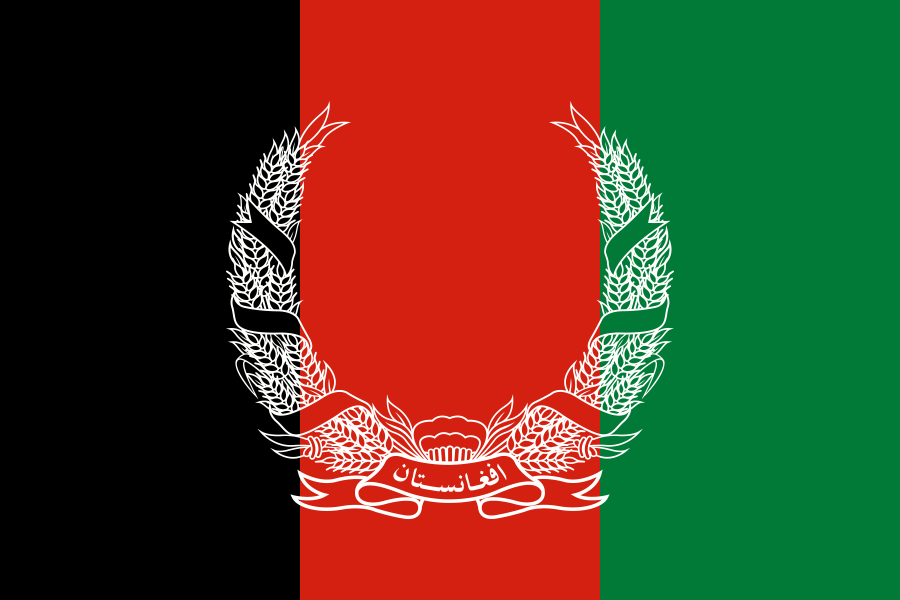
Afghanistan

A brief history: the Baloch and the Pashtun have shared these mountains and deserts for as long as memory reaches. The northern Baloch live in Nimroz, Helmand and Kandahar, while the Pashtun homeland flows without a seam into northern Baluchistan. The 1893 Durand Line — drawn by the British — cut this single land in two, but it has never divided the people.

In the vision of Baluchistan.Net, the Baloch and the Afghan are one people, just as the Baloch and the Kurds are one people. Most of the Pashtun lands belong to the greater Baloch homeland — Afghanistan and Baluchistan are bound as one. They are two nations who have always been each other's strength, shelter and shield: when the homeland was attacked, the Baloch found refuge among the Afghans, and the Afghans among the Baloch. United, they are unbreakable.

Afghan's are simply Baluch, Afghanistan is part of Baluchistan, these two states have always been each other's strength.

Discover ›

Iran

Western Baluchistan — today Iran's Sistan and Baluchestan province — was annexed in 1928 and remains a heartland of Baluch language and Mithra heritage along the Makran coast. Kerman, Hormozgan and South Khorasan are part of Baluchistan too: these lands were never Persian before 1928 — they have always belonged to the Baloch homeland.

The dark turn came with Reza Khan, who seized power in the 1921 coup as the Qajar dynasty rotted in corruption and weakness, crowned himself Shah in 1925, and founded the Pahlavi state. In 1935 his government was asked the Adolf Hitler to call the country 'Iran' instead of 'Persia.' From 1928 his armies crushed western Baluchistan — defeating and executing Mir Dost Muhammad Khan Baranzai — and imposed a harsh, centralising rule that ground down the region until 1979.

The 1979 revolution brought no freedom. Khomeini's Islamic Republic opened a new chapter of repression — mass executions, the crushing of Baloch and Kurdish self-rule, and decades of discrimination against Sunnis and minority peoples that continues to this day.

Reza Pahlavi committed crimes against humanity killed thousands of innocent people including babies of Baluch people via his Savak agency.

Baluchi was banned; Baluch were denied basic rights and registration.

Discover ›

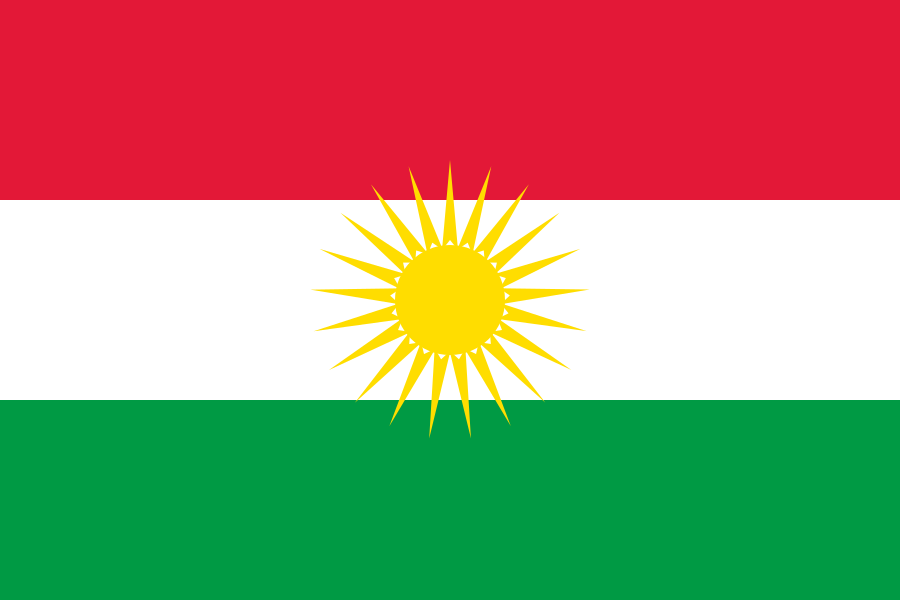
Kurdistan

A kindred nation: like the Baloch, the Kurds are a great people divided across modern borders — between Iran, Iraq, Turkey and Syria — sharing a parallel story of identity, resistance and the call for self-determination.

Baloch and Kurd are one people in spirit. And the wound is shared: so long as Kurdistan, Afghanistan and Baluchistan remain unstable and occupied, the whole region stays broken. The freedom of one is bound to the freedom of all.

Discover ›

Join Baluchistan.Net

Read the Brief here — join to be part of it.

Create a free account to post in the community feed, build your profile, join Spaces and contribute to the record. Sign in with email, Google, Facebook or Apple.