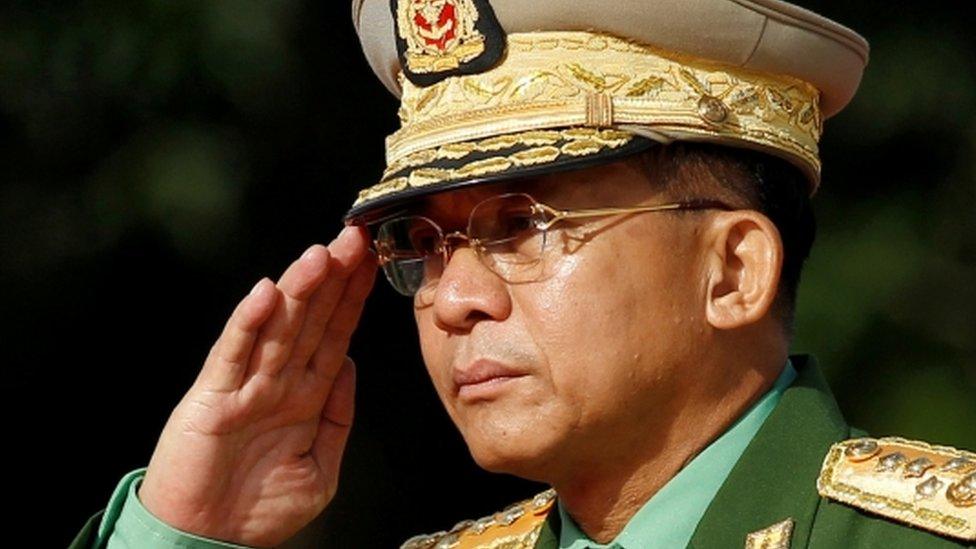
Myanmar leader breaks diplomatic isolation on first official visit to Thailand since coup
The BBC's Jonathan Head explains what the meeting between the leaders means
- Published6 August 2026, 04:36 BST
Myanmar's military leader Min Aung Hlaing has arrived on an official visit to Thailand, his first since he launched the coup that ousted Aung San Suu Kyi's elected government in 2021.
The coup ignited a civil war, which has killed thousands of people and wrecked the economy.
Min Aung Hlaing, who was already subject to sanctions over his involvement in the mass expulsion of Muslim Rohingyas in 2017, has been an international pariah, barred from western countries and accused of crimes against humanity.
He was declared president in April and left his position as military commander, following an election which was widely condemned for being neither free nor fair.
The main opposition parties were barred from taking part, and there was no voting at all in large areas of Myanmar controlled by armed insurgents, ensuring that the military's own party now dominates the new parliament.
Min Aung Hlaing has been barred from attending meetings of the Association of South East Asian Nations (Asean) over his refusal to implement a five-point consensus which he and other Asean member states signed in 2021. It required the Myanmar military to de-escalate violence and start negotiations with opposition groups.
Some Asean states, in particular Indonesia, Malaysia, the Philippines and Singapore, want to see more concessions made by the military in Myanmar to ease the humanitarian crisis there and end the civil war before full diplomatic contact can be restored.
However, Thailand is pursuing what it calls "calibrated re-engagement" with the regime in Myanmar, arguing that because they share a 2,400 km border they need to be talking to each other at the highest levels of government to address issues like transnational crime.
That diplomatic engagement by Thailand is moving quickly this week, and looks very much like business as usual.
Min Aung Hlaing was given a red-carpet welcome by the Thai prime minister Anutin Charnvirakul. He will be attending an official dinner, meeting the leaders of both houses of the Thai parliament, and presiding over a Thai-Myanmar business forum to boost the economic ties between the two countries.
On Thursday evening, the two leaders released a joint statement that pointedly avoided any mention of Asean's concerns over Myanmar's failure to honour the 2021 consensus, and barely mentioned the civil war at all.
The main focus was on rebuilding economic ties, which is something the Thai business community wants and managing border issues.
There was a lot of references to co-operation on security, something that the Thai military, which has significant influence over Thai policy towards Myanmar, wants.
The statement has no hint of any Thai concerns over the disastrous costs of the civil war, although Foreign Minister Sihasak Phuangketkeow did tell journalists that Thailand wants the violence to be reduced and to see both sides in the conflict show a willingness to negotiate.
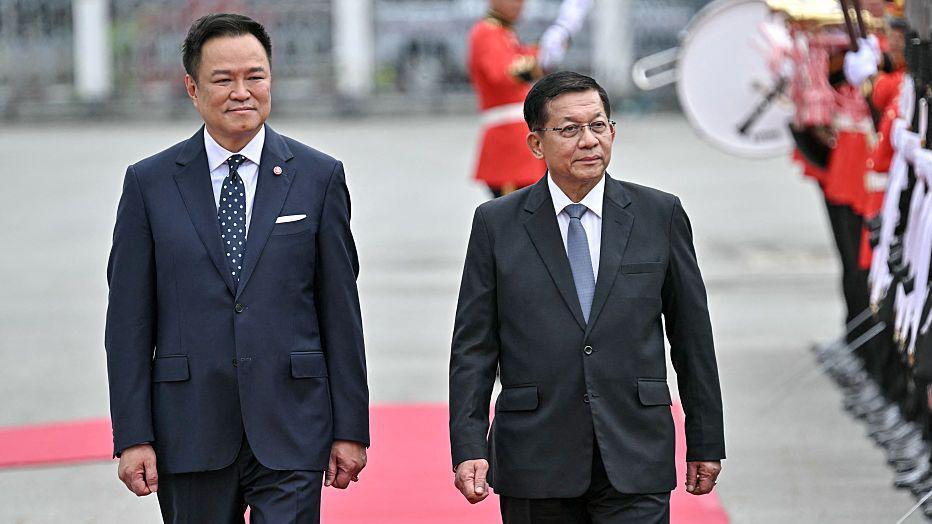 Image source, Getty Images
Min Aung Hlaing has been an international pariah, barred from western countries and accused of crimes against humanity
Thailand's decision closely follows what Myanmar's two largest neighbours, China and India, have done after the election.
Both have recognised the new government and invited Min Aung Hlaing for official visits soon after he became president.
China's support for the embattled military regime in Myanmar has been critical, helping it turn the tide on the battlefield and recapture some of the territory it had lost to armed opposition groups.
But the decision by Thailand, a democracy and a founder member of Asean, to give Min Aung Hlaing such a high-profile visit is attracting a lot of criticism.
"The Thai government continues to lend the junta false legitimacy through its ongoing diplomatic engagements," said the campaigning group Justice for Myanmar.
"Min Aung Hlaing's visit reflects Thailand's failed policy of 'calibrated re-engagement' with the military junta, which will only prolong the ongoing suffering of the people of Myanmar."
Millions opposed military rule in Myanmar. Is their dream of a revolution over?
- Published30 July
The general who returned Myanmar to military rule
- Published1 February 2021